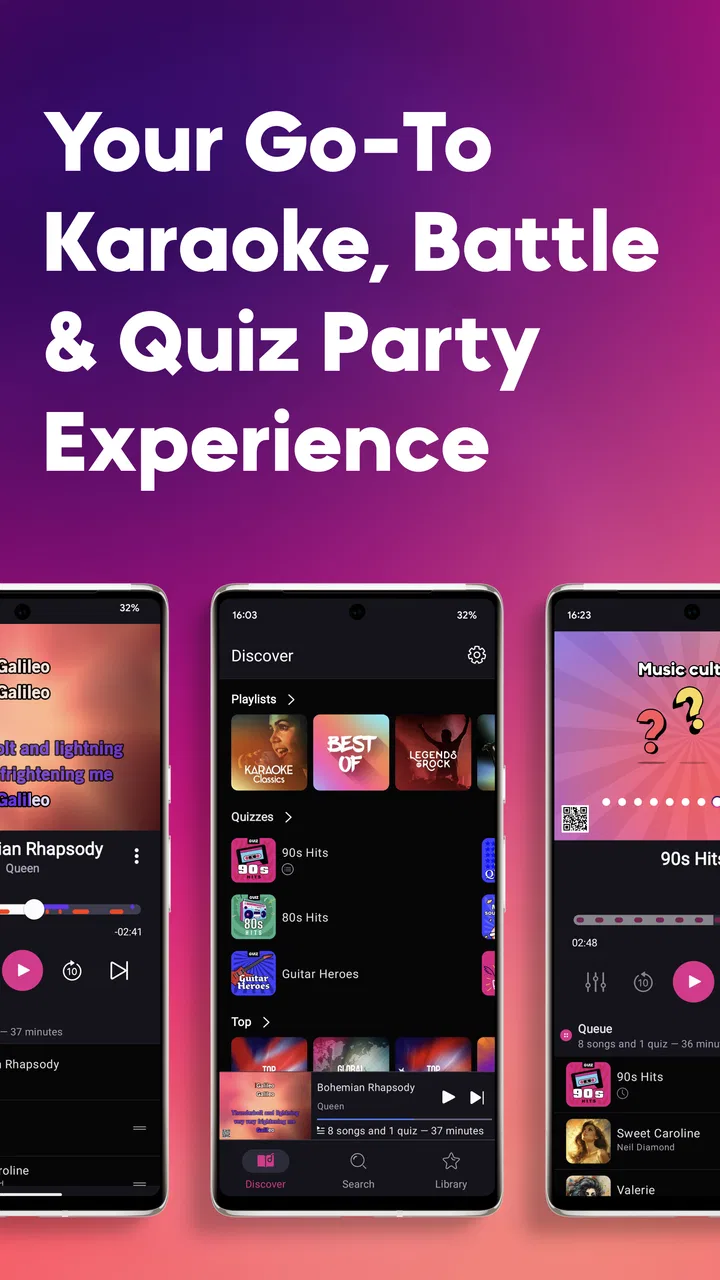
KaraFun: Karaoke, Battle, Quiz
- 4.6
- Rating
- 1.00M
- Installs
- Free
- Price

 Analysis by App-foxy
I tested KaraFun – Karaoke & Music Quiz as the sort of app that can turn an ordinary evening at home into a shared activity. It is a free Music & Audio app from Recisio, but the useful question is not simply whether it plays songs. The real appeal is how easily one person can start a karaoke session while others listen, choose what comes next, or join in when they feel brave enough.
That makes it more interesting than a basic music player, especially for households where a phone or tablet is passed around. I found the combination of karaoke and music trivia more flexible than a single-purpose singing app. You can use it for a relaxed singalong, a quick challenge between friends, or a short burst of entertainment when nobody wants to commit to a full game. The experience is not perfect, though, and the way you organize the session matters almost as much as the app itself.
How KaraFun Works When Several People Share the Room
The most natural use is a shared screen in a living room. One person holds the device, another chooses a song, and everyone else decides whether they are singing, judging, or simply enjoying the performance. I like that this arrangement does not require every participant to understand the app immediately. A confident user can handle the controls while newcomers concentrate on the lyrics and music.
You May Also Like

 Blood Strike: 2.5 Anniversary
Blood Strike’s Loadouts Turn Every Drop Into a Tactical Gamble
A close look at Blood Strike’s custom loadouts: how fast access to signature weapons reshapes its battle royale rhythm, rewards preparation, and narrows the gap between fights.

 Pandora - Music & Podcasts
Pandora’s Music Is Easy to Start, but Harder to Recover
Pandora’s strength is its low-effort path from a seed to a station. Its weak spot is how much confidence it asks you to place in connection, setup, and quiet recovery.

 8 Ball Pool
 Is Built on Rivalries, Rematches, and Routine
A close look at the rivalries, rematches, shared routines, and unanswered safety questions that turn a quick pool match into a persistent mobile community.

 Samsung Music
’s Quiet Strength Is Playing What You Already Own
Its reach comes less from spectacle than from dependable access to a personal library. That simplicity is both the app’s strongest retention engine and its ceiling.

 AccuWeather: Weather Radar
AccuWeather Review: A Quick, Clear Forecast for Everyday Decisions
For everyday plans, the best forecast is the one you can understand quickly. AccuWeather makes rain timing, radar, and local conditions easy to act on, with a few trade-offs.

 Hill Climb Racing
Why Hill Climb Racing Still Turns Crashes Into One More Run
A tiny car, a bumpy hill and one more upgrade: Hill Climb Racing keeps resurfacing because its simple chaos makes every near-miss feel personal.
More From Our News Desk
View All News


The music quiz side gives the evening a second rhythm. Karaoke can become repetitive if the same few people keep taking turns, but trivia creates a way for quieter guests to participate. Someone who does not want to sing can still identify a track, recognize an artist, or help choose the next challenge. That balance is one of the strongest reasons I would recommend it for a mixed group.
For a household, I would treat the device as a shared entertainment station rather than a personal music library. Before starting, I would place the phone or tablet where everyone can see it and agree that song selection rotates. This small rule prevents the familiar problem where one person becomes the permanent operator and everyone else waits.
A useful trick is to separate the evening into short rounds. Start with a song that most people know, follow it with a quiz moment, and then allow the next participant to choose. This keeps the app feeling social instead of turning into a long queue controlled by a single person. It also makes the experience easier for guests who may only want to stay for a few minutes.
What the Shared-Screen Experience Gets Right
The app’s format suits people with different confidence levels. A strong singer can perform, an occasional singer can join for a chorus, and a reluctant participant can take part through the music quiz. That range is more valuable in practice than a large collection of isolated features because a household rarely has one identical taste or comfort level.
I also found the karaoke format useful for breaking up passive screen time. Instead of everyone silently watching a video, the room has a reason to react. People listen for mistakes, recognize familiar melodies, and make decisions together. The app works best when the goal is shared amusement rather than a serious vocal performance.
There is a trade-off: a shared device means shared attention. If one person wants a private listening session with headphones, this is not the ideal setup. KaraFun feels most convincing when the room is part of the experience. It is less compelling as a quiet background player than a conventional streaming service or a personal music app.
Setting Up Without Blurring Personal and Shared Use
Because the app is free to install and carries a Teen content rating, I would decide before the first session who is responsible for setup and purchases. The free entry point is convenient for trying the experience, but in-app purchases range from $6.99 to $59.99 per item. That makes it sensible to keep the person managing the device involved whenever the group explores paid options.
I would not hand the device to a child and assume that a shared karaoke session is automatically simple. The age rating is a useful reminder that the household should consider who is present, what songs are being selected, and who can approve spending. This is not a criticism of the karaoke idea; it is basic organization for any app used by several people.
Account boundaries deserve attention as well. If different members of the household use the same device, decide whether the session is communal or tied to one person’s account. Mixing personal choices, purchases, and preferences can become confusing later. I prefer one clearly designated organizer for group use, with everyone else treating the session as a shared activity rather than creating changes casually.
The app supports devices running Android 8.0 or later, so compatibility is worth checking before planning an event around it. In a mixed household, the oldest phone or tablet may be the limiting factor. I would test the intended device in advance, particularly if the main screen is an older tablet that normally sits unused.
Coordinating Songs, Turns, and Expectations
Karaoke apps often fail socially rather than technically. The music may be fine, but the group loses interest when nobody knows whose turn it is or when song choices take too long. With KaraFun, I recommend preparing a loose order before the first performance. It does not need to be formal: one song per person, then a quiz round, is enough to keep the pace moving.
For children and adults together, alternating choices works better than letting the loudest participant dominate. An adult can choose a familiar song first, a younger participant can choose the next one, and the quiz can give everyone a neutral turn. That structure makes the app feel fair without needing complicated rules or dedicated party equipment.
Another practical insight is to avoid treating every song as a full performance. Some guests will want to sing the entire track, while others may only want to try a verse. Allowing shorter turns reduces pressure and gives the music quiz more room. It also helps when the group’s tastes are far apart: nobody has to sit through a long selection they do not enjoy.
I would keep volume under control too. A phone or tablet speaker may be adequate for a small room, but a larger gathering can quickly become tiring if people have to shout over the music. The app can provide the content, but the room still determines whether the session feels comfortable. If sound quality is the priority, a dedicated karaoke setup or a better audio system may be a stronger choice.
Age, Trust, and the Reality of a Teen-Rated App
The Teen rating means I would not present KaraFun as an automatic all-ages activity without adult judgment. A family can still enjoy it together, but the responsible adult should remain aware of the audience and the choices being made. The important distinction is between using the app as supervised entertainment and giving a young user unrestricted control of a shared account or device.
Trust also applies to spending. Since the app is free to begin with but includes paid items, I would make the payment boundary explicit before anyone starts browsing. A simple household rule such as “ask before buying” is more useful than assuming every participant understands which part of the experience is free and which part may cost money.
This is especially relevant when a child borrows a parent’s phone. The device may contain personal accounts, saved payment details, or other information unrelated to karaoke. I would keep the session supervised and return control to the owner afterward. That approach protects the household’s boundaries without pretending the app needs features that are not part of the experience.
For teenagers, the app can be a good social option because it gives them something active to do with friends. Still, I would encourage adults to focus on the group setting rather than leaving the app to define the evening. The best results come when people choose songs together, respect turns, and understand that not everyone wants to perform.
Where It Beats Ordinary Music Apps
A standard music player is better when I want uninterrupted listening, accurate personal recommendations, or a private session. KaraFun is better when the music is meant to create participation. Lyrics, singing, and trivia change the role of the listener: instead of consuming a track, the group reacts to it and uses it as a prompt for conversation.
It also has an advantage over a pure karaoke tool because the music quiz gives non-singers a reason to stay involved. That matters in real households, where one person may love performing and another may prefer guessing songs from a short clue or familiar melody. The app’s two-part identity helps it serve a broader group than a singing-only alternative.
On the other hand, people looking for professional vocal practice may want more specialized controls, detailed feedback, or equipment integration. I would not choose KaraFun solely to improve technique. Its strength is the shared moment, not the promise of turning a casual singer into a trained performer.
Likewise, a family that mainly wants carefully managed children’s entertainment may prefer an option designed specifically around younger users. KaraFun’s Teen rating calls for adult awareness, and the presence of purchases means it should not be treated like a completely consequence-free toy. The right choice depends on whether the household values flexible group fun more than tightly controlled simplicity.
Everyday Scenarios That Make Sense
Imagine a rainy Saturday afternoon. One family member wants music, another wants a game, and a third does not want to leave the sofa. KaraFun can bridge those preferences: begin with a familiar karaoke choice, let the non-singer handle the quiz, and rotate the device after each round. Nobody has to commit to being the star, and the activity can end naturally after a few songs.
It can also work at a small gathering where conversation has slowed. Instead of starting a complicated board game, the host can use the app for a quick music round. The low commitment is important. Guests can join for one song, guess an answer, or simply watch. That flexibility is more practical than an activity that requires everyone to learn rules before participating.
For a couple or two friends, the experience changes again. You can use the quiz to settle who chooses the next track, then turn the result into a playful singing challenge. I would keep the competitive tone light, because the app is most enjoyable when mistakes are part of the joke rather than something people feel judged for.
A shared tablet is particularly suitable if the household has one available. The larger display is easier for several people to read than a phone, and passing it around feels less awkward. The trade-off is that a tablet may not be the device with the best sound, so I would choose the screen based on visibility and the audio setup based on the room.
Practical Limits I Noticed
The biggest limitation is social dependence. KaraFun cannot create a good party by itself. If nobody wants to choose songs, sing, guess, or take turns, the app becomes another screen waiting for attention. I would recommend it to households that enjoy participating, not to someone seeking an entirely passive entertainment service.
Song selection can also expose differences in taste. A group may spend more time negotiating than singing if there is no plan. That is why I consider a rotating chooser and short rounds essential rather than optional. The app gives the household the tools for a shared session, but the household still has to provide the structure.
There is also a cost boundary to keep in mind. Free access makes trying it easy, yet the range of in-app purchase prices means the full experience can become a meaningful household expense. I would start with the free portion, judge whether people actually use it repeatedly, and only then consider paying for additional access. That is a better approach than buying first for a single planned evening.
The Teen rating may rule it out for families wanting an entirely child-focused environment. It can still be used responsibly with adults present, but I would not recommend it as an unsupervised default for younger children. The same applies to shared accounts: clarity about who operates the app and who approves purchases prevents avoidable tension.
Who Should Try It and Who Should Pass
I would suggest KaraFun to households that enjoy music, playful competition, and activities that do not require much preparation. It is especially suitable when one person likes singing and others prefer trivia or watching. The combination gives everyone a possible role, which is more useful than a karaoke app that assumes the whole room wants to perform.
It is also a good fit for casual hosts who want an activity that can start small and grow if the group responds well. You can test it with a few songs, introduce the quiz when attention drops, and stop without packing away a collection of equipment. That flexibility is its clearest everyday advantage.
I would skip it if my priority were private, uninterrupted listening, advanced vocal training, or a tightly controlled children’s environment. In those cases, a conventional music service, specialist singing software, or a child-oriented entertainment option would make more sense. KaraFun is not trying to replace every music tool; it is strongest in the space between a playlist and a party game.
My Household Verdict
After using it as a shared activity, I see KaraFun as a friendly bridge between karaoke and music trivia rather than a conventional audio app. Recisio has made something that works best when the device is placed in the middle of the room and the household agrees to participate. The free starting point lowers the barrier, while the purchase range means an adult should keep an eye on spending.
Its audience is broad enough for mixed groups, but the Teen rating and shared-account considerations should shape how families use it. I would set expectations, rotate control, and keep the first session short. Those choices solve more problems than simply installing the app and hoping the room becomes lively.
The app has reached over a million installs, and its average rating is 4.6 from around seventeen thousand ratings, which matches my impression that the concept works for many casual users. It has been available since November 14, 2011, and that long presence makes it feel like an established option rather than a novelty.
For me, the final decision is simple: KaraFun is worth trying when the goal is shared musical fun, not solitary playback. I would install it on the household device, let everyone choose a turn, use the quiz to include non-singers, and keep purchases under adult control. Used that way, it can turn a quiet evening into something people actively do together.
FAQs for KaraFun: Karaoke, Battle, Quiz
01What features does KaraFun offer for karaoke enthusiasts?
KaraFun provides a comprehensive karaoke experience with over 45,000 songs in various languages. It offers offline mode for singing without internet, customizable pitch and tempo, and dual screen display for larger audiences. Additionally, it includes a music quiz feature to test your song knowledge, making it perfect for parties and gatherings.
02Is KaraFun available for both Android and iOS devices?
Yes, KaraFun is available for download on both Android and iOS platforms. The app is designed to provide a seamless experience across devices, allowing users to access its extensive song library and features whether they're using a smartphone or tablet. Links to download are available on the official website.
03Does KaraFun require a subscription, or is it free to use?
KaraFun offers a free version with limited access to songs, but to unlock the full library and all features, a subscription is required. The subscription comes in various plans, including a weekly, monthly, or yearly option, catering to different user needs and offering flexible access to premium content.
04Can KaraFun be used offline, and how does this work?
Yes, KaraFun can be used offline. Users can download their favorite tracks while connected to the internet and access them later without connectivity. This feature is particularly useful for events in locations with poor or no internet access, ensuring uninterrupted karaoke fun.
05How user-friendly is the KaraFun interface for beginners?
KaraFun is designed with a user-friendly interface, making it accessible even for beginners. The app provides easy navigation, clear instructions, and simple controls for adjusting key features like song pitch and tempo. Its intuitive layout ensures that users can effortlessly enjoy karaoke sessions without any technical difficulties.
Pros
- Extensive song library to choose from.
- High-quality audio tracks ensure great sound.
- User-friendly interface for easy navigation.
- Offline mode available for on-the-go singing.
- Regular updates with new features and songs.
Cons
- Requires a subscription for full access.
- Some songs may not have lyrics available.
- Limited customization options for playlists.
- Occasional app crashes reported by users.
- Ads can be intrusive in the free version.

KaraFun: Karaoke, Battle, Quiz
Gallery